Marketing often feels like waiting for rain in a drought. You set up your website, post on social media, and run ads, hoping the right people will stumble upon you. But what if you didn’t have to wait? What if you could walk up to your ideal customer, tap them on the shoulder, and introduce yourself?
That is essentially what Cold Promotional Email Marketing is.
It isn’t about spamming thousands of strangers with a “BUY NOW” button. It’s the digital equivalent of a handshake. It is the proactive process of identifying potential clients who genuinely need what you have, and starting a conversation with them. For businesses ranging from local startups to enterprise giants, it remains one of the most effective ways to control your own destiny—generating leads and sales on your own terms, rather than at the mercy of an algorithm.
Here is how it works, why it breaks, and how to fix it.
The Hurdles: Why Most Cold Emails Fail
If cold email is so powerful, why does it have a bad reputation? Because most people do it wrong. When companies try to shortcut the process, they run into a wall. Here are the most common problems businesses face:
The “Black Hole” of Deliverability
You can write the greatest email in history, but if it lands in the Spam folder or the “Promotions” tab, it doesn’t exist. Many businesses neglect technical setup, causing Gmail and Outlook to flag them as untrustworthy immediately.
The “Spray and Pray” Method
Sending the exact same generic template to 5,000 people is a recipe for disaster. This leads to poor targeting and irrelevant audiences. If you try to sell steak to a vegetarian, your copy isn’t the problem—your list is.
The Invisible Subject Line
Low open rates usually stem from boring, click-bait, or salesy subject lines. If your subject line reads “Proposal for [Company Name],” you are likely getting deleted without a second thought.
The “Me, Me, Me” Syndrome
Most bad cold emails talk exclusively about the sender: “We are a web agency. We won an award. We want to sell to you.” There is no value for the reader, leading to low click-through rates (CTR).
The “One-and-Done” Mistake
Studies show most deals are closed after the third or fourth contact. Yet, many businesses send one email, get no reply, and give up. Without follow-up sequences, you are leaving money on the table.
Compliance Anxiety
Fear of GDPR (in Europe) or CAN-SPAM (in the US) stops many businesses before they start. Ignoring these rules can lead to fines, but fearing them too much leads to inaction.
The Fix: Solutions & Best Practices
To turn cold email into a revenue engine, you have to stop acting like a bot and start acting like a human—just at scale.
1. Technical Housekeeping (The Boring but Vital Stuff)
Before sending a single email, you must prove you are real. This means setting up your “digital ID cards”—SPF, DKIM, and DMARC. These are DNS records that tell email providers, “I am who I say I am.” Additionally, never use your primary domain for cold outreach. Buy a secondary domain (e.g., instead of company.com, use getcompany.com) to protect your main website’s reputation.
2. Warm-Up Strategies
You cannot go from 0 to 1,000 emails a day. You need to “warm up” your email address. Start by sending 10-20 emails a day and gradually increase the volume over a few weeks. There are AI tools that can automate this for you, interacting with other inboxes to signal to Google that you are a legitimate human sender.
3. Hyper-Segmentation & Targeting
Don’t build a list of “CEOs.” Build a list of “CEOs of SaaS companies in Austin with 10-50 employees using HubSpot.” The narrower your niche, the easier it is to write copy that resonates.
4. The “Value-First” Copy
Your email should not be a sales pitch; it should be a conversation starter.
- Subject Lines: Keep them boring but curious. “Question about [Project]” often outperforms “SPECIAL DISCOUNT INSIDE.”
- The Hook: Mention something specific about them (Personalization at scale).
- The Offer: Don’t ask for a marriage (the sale); ask for a coffee (a quick chat).
5. Automation with a Human Touch
Use email outreach tools (like cold Email Sender ) to set up “Drip Campaigns.”
- Email 1: Value-based intro.
- Email 2 (3 days later): A quick bump or a relevant case study.
- Email 3 (5 days later): A breakup email (“I won’t bother you again, but here is a resource if you need it”).
6. Stay Legal
It’s actually simple. Include a physical mailing address in your footer and an easy way to opt-out (unsubscribe link). Most importantly, only email people who have a “Legitimate Interest” (B2B logic) in your service.
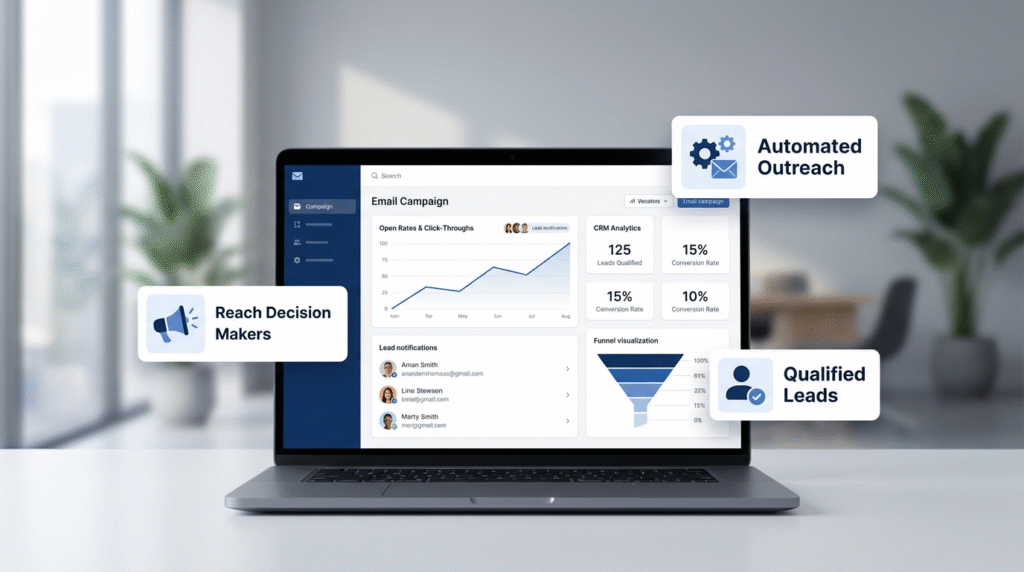
Case Study: The Pivot from “Spam” to Strategy
Note: This is a universal example based on real-world data patterns.
The Business: A mid-sized IT Consulting Firm.
The Problem: They relied entirely on referrals. When the referrals dried up, their revenue flatlined. They bought a cheap list of 10,000 emails and blasted a generic brochure.
- Result: 2% Open Rate, 0 meetings booked, and their domain got blacklisted.
The Strategy Shift:
- New Infrastructure: They bought a new domain (
consulting-partners.com) and warmed it up for 3 weeks. - Better Data: They scraped a list of CTOs specifically at companies that had recently raised funding (signaling they had budget and growth pains).
- The Angle: Instead of pitching “IT Services,” they pitched a solution to a specific pain: “Handling the security risks of rapid hiring.”
- The Sequence: They ran a 4-email sequence focusing on advice, not sales.
The Results:
- Open Rate: Jumped from 2% to 55%.
- Reply Rate: 8% (Industry standard is usually 1-3%).
- Outcome: Within 60 days, they booked 24 qualified sales calls, resulting in 3 closed contracts worth $150k in annual revenue.
The Lesson: They stopped trying to sell to everyone and started trying to help a specific someone.
FAQs: Common Questions Answered
1. Does cold email still work in 2025?
Yes, arguably better than ever—but only if you avoid the “spammy” tactics of 2015. Since social media reach is declining due to algorithms, email remains the only channel where you own the connection.
2. How many emails should a business send per day?
Per inbox, keep it under 30 to 50 emails daily to stay safe. If you need to send 500 emails a day, set up 10 different email accounts.
3. What is a good open rate?
If you are doing it right, aim for 40% to 60%. Anything below 30% suggests a problem with your subject line or your deliverability (you might be in spam).
4. How long should my cold email be?
Short. Ideally, under 150 words. Mobile readers skim. If they have to scroll, you’ve lost them.
5. Is cold emailing illegal?
No. In the US (CAN-SPAM), you can email anyone as long as you offer an opt-out. In Europe (GDPR), B2B outreach is generally permitted under “Legitimate Interest,” provided the product is relevant to their job. Always check local laws.
6. How often should I send follow-ups?
Wait 2-4 days between emails. A typical sequence is Day 1, Day 4, Day 8, and Day 14.
7. How do I build a high-quality email list?
Avoid buying cheap lists from questionable marketplaces. Use tools like Apollo, LinkedIn Sales Navigator, or Crunchbase to verify data yourself, or hire a lead-generation specialist.
8. What tools should I use?
You need three types: A source for leads (e.g., Apollo), a verification tool (e.g., MillionVerifier), and a sending tool (e.g., Instantly or Smartlead). Do not use Mailchimp or ConvertKit for cold traffic; they will ban you.
9. How do I avoid the spam folder?
Don’t use “trigger words” like Free, Guarantee, $$$, or Risk-free. Keep your HTML minimal (text-only emails often perform best) and ensure your technical DNS records are perfect.
10. How can small businesses benefit from this?
It levels the playing field. A small business with a great offer and a personalized email can beat a massive corporation that sends generic automated newsletters.
Conclusion
Cold promotional email marketing is not about tricking people into opening a message; it is about solving problems for people who haven’t met you yet.
When done correctly, it is one of the highest ROI channels available because it is low cost, highly scalable, and targeted. It removes the reliance on “hope marketing” and puts the control back in your hands.
The secret isn’t a magic subject line or an expensive tool. It’s empathy. If you can understand your prospect’s pain better than they do, and articulate a solution clearly and respectfully, their inbox is open to you.
Ready to grow? Stop waiting for the phone to ring. Draft that first email, focus on value, and hit send.